


Tractor T-40
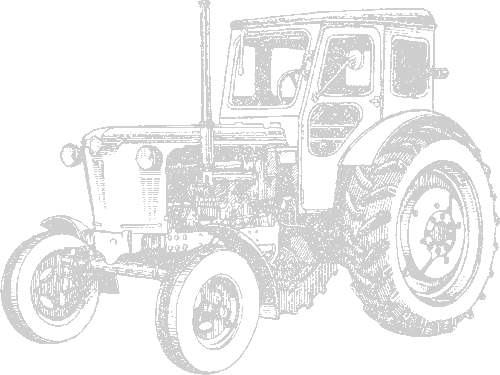 The tractor is designed for ploughing light soils in gardens and greenhouses, processing row crops, for working with a mower, hay sweeper, snow blade, as well as for transport work. The tractor has a semi-frame layout with a supporting gearbox and rear axle. The engine is mounted on a semi-frame rigidly connected to the gearbox housing. The tractor was produced in all-wheel drive (T-40A) and rear-wheel drive versions. The rear drive wheels have an increased diameter and a rigid suspension,
The front guide wheels are of reduced diameter and on a spring suspension; the tread has characteristic, recognizable herringbone lugs, which significantly increase the already quite high cross-country ability. The tractor has an adjustable track and adjustable ground clearance of all wheels; replaceable rear wheels of reduced width can be installed. To work on steep slopes, the track can be increased by installing the rear wheels “inside out”; the disc plane of the wheels is asymmetrical. With some improvements, the tractor is capable of carrying double wheels.
The tractors are equipped with a four-cylinder, four-stroke air-cooled diesel engine D-37, or D-144, produced by the Vladimir Tractor Plant. The power of the D-37 engine is 37 hp, and the D-144 engine is 50 hp. The engine is started using an electric starter or (on some tractors) a PD8 starting gasoline engine.
The transmission is mechanical, fully reversible, allowing the use of the entire speed range both in forward and reverse, also with mounted implements (for other types of wheeled tractors, reverse gear is intended only for maneuvering). An interesting feature of the tractor is the placement of the bevel gearbox immediately behind the clutch and, accordingly, the transverse arrangement of the gearbox shafts. Installation of a mechanical or hydraulic creeper is provided for
work at low (less than 2 km/h) speeds. The tractor has two multi-mode independently controlled power take-off shafts - rear and side, which also expands the functionality of the tractor.
Another feature of the T-40 tractor is its modular compatibility with mounted and trailed machines designed for tractors of related classes - the lighter T-25 and the heavier Belarus family. These circumstances, as well as a successful combination of performance qualities, ensured the tractor wide recognition throughout the USSR.
The disadvantages of the T-40 tractor include the intense thermal regime of the air-cooled engine in the summer and underheating of the engine in the winter, ineffective cabin heating (again due to air cooling), and difficulty starting the engine in the winter.
The high safety margin of the transmission and chassis components ensured the tractor high durability - most of the tractors produced in the 70s - 80s are still in use, both at enterprises and on private farms. The ongoing production of spare parts allows us to maintain these tractors in good technical condition.