


Improving sowing technology
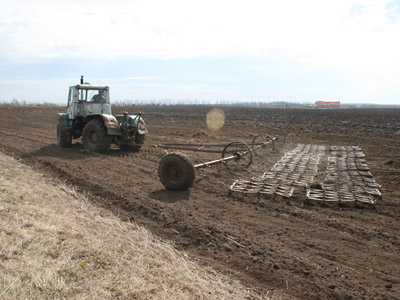 Due to the lack of necessary machines and combined units, often the last operation before sowing is harrowing or cultivation with harrowing. According to agrotechnical requirements, after harrowing there should be no lumps larger than 3 cm on the soil surface, the depth of the furrows should not exceed 2 - 3 cm. However, research results indicate that after this agricultural practice, lumps 6 - 12 cm in size are found on the soil surface (especially in dry years);
the depth of the furrows reaches 5 - 7 cm, and the width - 6 - 10 cm. Such pre-sowing treatment does not provide the specified depth of seed placement.
In practice, soil compaction is used with rollers of various types. However, without leveling the surface, this agricultural technique does not satisfy the requirements of agricultural technology, since after the passage of the roller, the volumetric mass of the soil at the depth of seed placement ranges from 0.9 to 1.3 g/cm3. When the roller passes over ridges and blocks, load concentration and, consequently, excessive compaction are observed in these places, and the opposite occurs in places of microdepressions. The connection of trail harrows, rollers and seeders, although
brings the embedding conditions closer to the specified ones and reduces the cost per unit of production, however, such a unit is difficult to operate, it is difficult to maneuver and, as a rule, operates at speeds of 5 - 7 km/h.
Currently, the industry of our country does not produce working bodies that would level and compact the soil in one pass without increasing the length of the seeder unit and could be used together with it, as well as similarly in other units.
Serially produced rollers and levelers practically cannot be used as part of mounted and even semi-mounted combined soil-cultivating and soil-cultivating-seeding units due to the increase in their length, the removal of the center of gravity of the unit from the places where it is connected to the tractor, which leads to deterioration in controllability and maneuverability.
Existing trail-type levelers have one common drawback - clogging and enveloping the working surfaces with plant residues, sticking with soil. They do not provide the uniformity required by agricultural technology.
Another group of tools for pre-sowing leveling used in our country are levelers, which have a significant drawback - high traction resistance, since they move a significant volume of soil in front of them. In addition, they are large in length and weight, cannot operate at speeds exceeding 4 - 6 km/h, and are not applicable as part of combined units.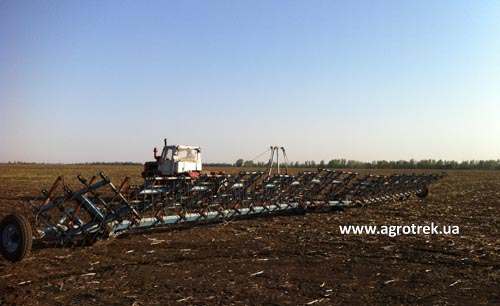
In a system of combined units, the surface leveler prepares the soil for uniform compaction with a roller both in depth and in working width. In this case, the roller, as a rule, performs a double function - it determines the depth of travel of the loosening working elements (passive or active) and compacts the soil to a certain amount. The volumetric mass of the soil after the passage of the soil-cultivating part of the unit can change by increasing or decreasing the load on
roller, redistribution of the mass of the entire unit by the position regulator of the hydraulic system of the tractor or UES-2-250A “Polesie”, and also by the linkage rods. This allows you to install a lightweight roller in comparison with ring-spur rollers 3 KKSh-6 or smooth rollers 3 KVG-1.4, etc. In addition, when changing the speed of movement, this method allows you to maintain the soil density constant. However, this requires special experiments and study.
A number of researchers have been studying the issues of mechanization of pre-sowing surface leveling and compaction of underlying soil layers: Frolov V.P. and Doganovsky N.G. ; Vagin A.T., Mikhasenok E.M., Emets N.A. ; Titov V.S. and Tretyakov N.M. ; Buntush T.A., Shpyta M.V. ; Kolyasov F.E., Zhuchenkov K.K. ; Shevelyagin A.I., Enzak L.V. etc. There are practically no works on studying the issues of soil leveling and compaction in a system of combined units.
A brief review of research and tools for pre-sowing leveling and soil compaction, a review of combined machines shows that they all process the soil differently and with unequal quality. Their diversity indicates the absence of a tool or working device that simultaneously levels and compacts the soil before sowing.
In this regard, there is a need to find and study a working body that has a low mass, is capable of adjusting to a given volumetric mass depending on the type of soil and the crop being sown, and ensures performance in accordance with agrotechnical requirements.
The most promising, in terms of use as part of combined units, may be a vibration leveler-compactor. Machines of this type are widely used in road and construction, as they consume less energy and have relatively high operating efficiency.