


The influence of frost on the starting of diesel engines
The use of tractors and cars in winter is accompanied by large losses of working time, labour and material resources for the operation, maintenance, repair and storage of machines. Downtime and labour costs, wear of parts and the number of engine failures increase especially noticeably during the period of pre-start preparation and start-up, the duration of which at temperatures below minus 30°C reaches 10...20% of the work shift time or more. At low temperatures, operating performance changes
properties of fuel and lubricants, unfavorable conditions are created for the operation of fuel supply equipment and electrical equipment. The increasing viscosity of fuel and oils makes it difficult to crank the engine when starting and causes increased wear of its parts.
The efficiency of using tractors and cars largely depends on the technical condition of the most complex and expensive unit - the engine, the durability and trouble-free operation of which are determined by climatic conditions, load, speed, temperature conditions, quality of service and many other factors. The influence of these factors increases with decreasing ambient temperature. In winter conditions, especially
During the start-up and warm-up period, the number of engine failures, labour costs for their elimination and machine downtime when preparing engines for operation increase. It is enough to note that machine downtime due to difficulty starting the engine at temperatures of minus 25...30 °C and below often reaches 1.0...1.5 hours or more. At the same time, during startup modes, the wear rate of the main joints increases, which reduces the durability of the engine.
Starting the engine consists of the following main stages:
initial acceleration to the starting speed of the crankshaft;
rotation of the crankshaft at an approximately constant frequency until the first flashes in the cylinders (scrolling);
rotation of the crankshaft with partial use of indicator power;
transition to independent work mode;
operation in idle mode.
In practice, the probability of successfully starting an engine in winter on the first attempt is low (about 10%), since the process can stop at any stage.
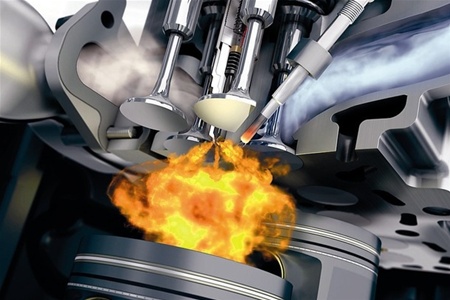 In the first stage, the crankshaft is turned by the engine starting system (fuel supply is turned off). The second stage lasts from the beginning of its stable rotation by the starting system until the start of fuel supply to the engine cylinders. The third stage begins from the moment the fuel supply is turned on and is characterized by unstable engine operation. The energy obtained from fuel combustion is not sufficient to increase the crankshaft speed, which ranges from 3...5 s-1 (revolutions per
second). Immediately after turning on the fuel supply, missed flashes of the combustible mixture are observed - up to 40% of the total number of fuel injections into the engine cylinders. The angular frequency of the crankshaft varies within 150...200 min-1. The maximum combustion pressure during the first outbreak reaches 8.5.105 N/m2, then decreases to 105 N/m2. The maximum value of the rate of pressure increase during the combustion process (hardness) during the first outbreak reaches 3.1.105 N/m2 deg; the average stiffness pressure is 1.8.105 N/m2 deg.
In the transient operating mode, the combustion of fuel releases energy sufficient to accelerate the rotation of the crankshaft from 4...5 s-1 to the maximum value (idling mode) and independent operation of the engine. The misfiring stops and the maximum combustion pressure gradually decreases. The engine is considered to be in self-running mode if the number of flashes per two crankshaft revolutions has reached 75%. When the engine is idling
During the stroke, the crankshaft rotation frequency fluctuates within narrow limits, the average value of the maximum combustion pressure is almost equal to the compression end pressure.
Low air temperatures and the associated cooling of units and operating materials make it difficult to start the engine and reduce the stability of individual engine systems in all modes. Difficulties in starting the engine arise due to the difficulty of creating a starting speed of the engine crankshaft, deterioration of the conditions for mixture formation and ignition of the mixture. Common reasons that make it difficult to start cold diesel engines at low temperatures include:
an increase in the moment of resistance to turning the engine crankshaft, caused by increased oil viscosity; a decrease in the temperature of the air entering the engine, which leads to a decrease in the temperature of the fuel mixture at the end of compression. Starting a diesel engine is possible only when the temperature at the end of the compression stroke in the combustion chamber reaches 350...400˚С. So, for example, at an engine speed of 190 min-1 and an ambient temperature of 0 C, fuel injection reduces the temperature
mixture at the end of the compression stroke by 130˚C; a decrease in the temperature at the end of the compression stroke due to intense heat transfer into the cylinder walls leads to a decrease in the average indicator pressure developed by the engine; increased air leakage through the gaps in the mating parts of the CPG due to slow cranking of the crankshaft; increase in fuel viscosity, formation of paraffins and deterioration of its spray pattern by injectors; deterioration of battery performance.
To ensure reliable starting of a tractor engine, it is necessary that the air temperature at the end of compression be higher than the auto-ignition temperature of the fuel. The self-ignition temperature of diesel fuel in an atomized state is 400 °C, and the air temperature at the end of the compression stroke reaches 700 °C (under normal operating conditions). To heat the air to the specified temperature, it is necessary to compress it to (300…350) 104 N/m2. However, in the cold season, even high pressure does not
ensures heating of air to the required temperature at the end of the compression stroke. The temperature of the air charge in winter decreases as a result of a number of factors.
Firstly, highly cooled outside air is supplied to the engine cylinders, which is not heated by the cold cylinder liners during intake. Secondly, during compression (at low crankshaft speeds), a large leakage of air occurs through the gaps between the piston and the cylinder liner. At a crankshaft rotation speed of 50...75 rpm, air charge leakage averages 24% (at compression ratio = 16) of the total volume of air entering the cylinders
engine. When the angular frequency of the crankshaft increases to 200 min-1, air leakage through the gaps decreases to an average of 5%.
When starting a cold engine, due to increased heat exchange between the air charge and the cylinder walls, the increase in the temperature of the compressed air slows down, and, consequently, the conditions for self-ignition of the fuel worsen. In addition, injection of cold fuel into the combustion chamber leads to an increase in surface tension and kinematic viscosity of the droplets. This affects the fact that the mass and kinetic energy of each drop increases, their total force decreases.
aerodynamic braking. As a result, the intensity of droplet deceleration decreases, and only a small part of the cyclic feed is suspended in the volume of the torch. All this leads to an increase in the time for warming up, evaporation and ignition of the fuel, and as a result, the combustion process is disrupted and the harshness of the engine increases. Starting the engine in the cold season is also made more difficult by the fact that the auto-ignition temperature of diesel fuel increases with
decrease in pressure in the combustion chamber. For example, if at a pressure of 30 MPa the self-ignition temperature of the fuel is 200 °C, then at a pressure of 1 MPa it reaches 400 °C [14].
In winter, it is especially difficult to start engines with electric starters, as the performance of the batteries deteriorates. The viscosity of the electrolyte increases. The electrolyte slowly penetrates the pores of the active mass of the plates of the battery cells, as a result of which the useful output of the batteries, especially when discharging with high currents, for example when the starter is operating, is significantly reduced. Experiments on starting the PD6-150 engine at various negative values
temperatures (from minus 16 to minus 34 °C) showed that even at an electrolyte temperature of minus 16 °C in batteries with an operational state of charge (80% of the nominal capacity), starting an engine heated to 60 °C was impossible due to low starting speeds developed by the starter and a significant loss of capacity of cold batteries.
The starting process and the stability of the operating process parameters of diesel engines in winter are greatly influenced by the viscosity and pour point of the fuel, on which the quantity and uniformity of fuel supply by the high-pressure pump, the quality of its atomization by nozzles and mixture formation in the cylinder depend. As the temperature decreases, the viscosity of diesel fuel increases, and due to the release of paraffin crystals, it becomes cloudy and even solidifies, losing its mobility. Dropped
Hydrocarbon crystals clog fuel filters and fuel lines, which first disrupts and then completely stops the fuel supply.
Factors influencing the ignition and combustion of the working mixture when starting the engine in winter conditions can be divided into those that can be controlled during operation and structural ones that cannot be controlled. For example, the quality of the fuel system depends on the type of fuel, its cetane number, and temperature. In operation, these parameters can be influenced by adding flammable liquids, selecting fuel with an appropriate cetane number,
by heating it before feeding it into the engine.
At low temperatures, the throughput of filters deteriorates due to their clogging with H-alkane crystals and ice crystals. This interference can also be eliminated by heating the fuel filters